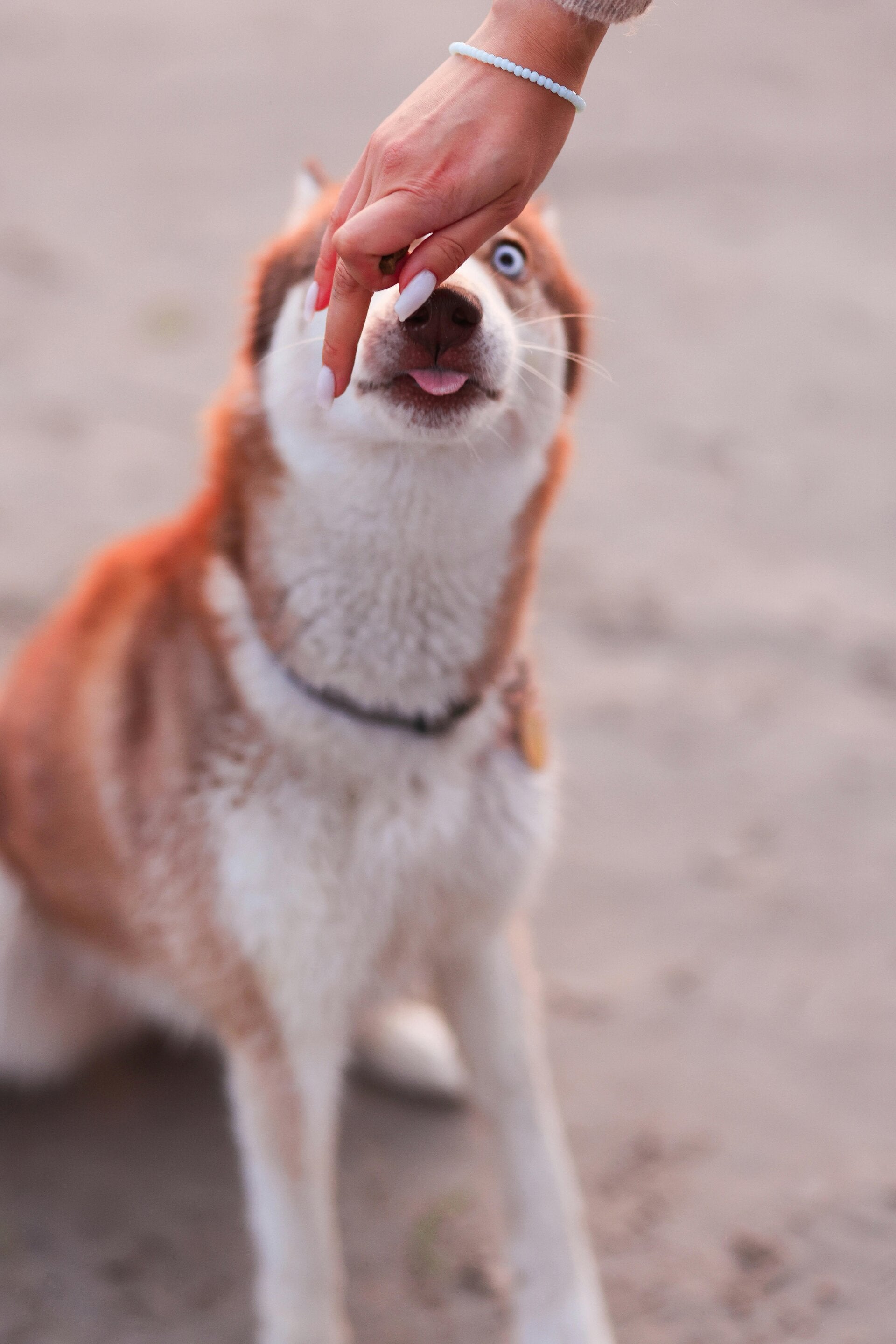
The Art of Luring: The Dog Training Cheat Code (That You Must Eventually Give Up)
There is a moment in every dog training class when handlers discover the most powerful tool known to dog training.
Not timing.
Not body language.
Not years of experience.
No.
The most powerful tool is…
The treat in your hand.
Suddenly dogs that previously had the attention span of a caffeinated squirrel are staring at their handler like they’ve just discovered the meaning of life.
You lift your hand with food and magically your dog sits.
Move it up slightly and your dog’s bum hits the floor like they’ve been professionally trained for years.
People look at their dog in amazement.
“Wow! They’ve got it!”
And I have to gently break the news.
“No… they’re following the biscuit.”
Welcome to luring.
One of the most useful tools in dog training… and also one of the easiest traps to fall into.
What Is Luring?
Luring is when we use food (or sometimes a toy) to guide the dog into a position or behaviour.
The food acts like a magnet.
The dog follows the food.
The body follows the nose.
And suddenly the dog is sitting, lying down, spinning, weaving, or doing something else clever.
For example:
Move the food up and slightly back → the dog sits.
Move the food to the floor → the dog lies down.
Move the food in a circle → the dog spins.
It’s quick.
It’s clear.
And for dogs who are still learning how training works, it can make the first step incredibly easy.
Think of it as training with sat-nav.
You’re guiding the dog to the destination.
Why Trainers Use Lures
Luring helps dogs understand what behaviour we’re looking for without confusion or frustration.
Instead of waiting for a dog to randomly offer a behaviour, we can guide them there.
It can be especially useful when:
• Teaching brand new behaviours
• Working with dogs that are easily frustrated
• Helping dogs move their body into unfamiliar positions
• Building confidence in early training
For a dog that has never done a down before, a lure can explain the whole thing in seconds.
It’s clear.
It’s simple.
And dogs usually think it’s brilliant.
Because snacks.
The Problem With Forever Luring
Here’s where things can go wrong.
Some dogs end up with a training routine that looks like this:
Handler waves food around like a magician.
Dog follows the snack.
Dog performs behaviour.
Handler gives snack.
Repeat.
The dog is basically thinking:
“I am not doing this because you asked.
I am doing this because the food is right there.”
Remove the lure and suddenly the dog looks at you like you’ve just asked them to do complex algebra.
“Sorry… I was just following the biscuit.”
This is why trainers often say:
A lure is a teaching tool, not a permanent crutch.
The Goal: Train Out the Lure
Luring is brilliant for explaining a behaviour.
But once the dog understands the movement, we need to start removing the lure.
The transition looks like this:
Food in hand → guide the dog.
Then…
Same hand motion → food appears after the behaviour.
Then…
Hand signal → reward from the other hand.
Then…
Cue + hand signal → reward appears from somewhere else entirely.
Suddenly the dog isn’t following food anymore.
They’re responding to a cue.
And that’s when the behaviour becomes real training.
Enter the Three D’s (Again)
Once the lure is gone and the dog understands the behaviour, we build reliability using the famous Three D’s.
Distance
Can the dog perform the behaviour without you hovering over them?
Duration
Can they maintain the position for longer?
Distraction
Can they still do it when the world gets interesting?
Because a sit in your quiet living room is one thing.
A sit when another dog runs past, someone drops food nearby, and a pigeon takes off dramatically?
That’s the real test.
When Luring Goes Wrong (And It Happens A Lot)
If you’ve ever seen someone walking around with a dog glued to their hand like it contains the secrets of the universe… chances are the lure never got phased out.
Dogs are smart.
Very smart.
If the food is visible every time, they quickly learn:
“No food… no service.”
This is why good trainers fade the lure quickly.
Otherwise you accidentally train a dog that only works when snacks are waving around like a bribe.
Luring Is Still A Brilliant Tool
Despite the risks, luring is still one of the fastest ways to teach many behaviours.
Used properly it helps dogs:
• Learn quickly
• Move their body confidently
• Understand new exercises without frustration
And for handlers it can make early training feel less intimidating.
But like training wheels on a bike…
They’re there to help you start.
Not to stay on forever.
The Moment It Clicks
At some point a handler realises they’ve asked their dog for a behaviour…
Without food in their hand.
And the dog does it anyway.
That’s the moment the lure has successfully become a cue.
The dog isn’t chasing the biscuit anymore.
They’re responding to communication.
And that’s when training really starts to look smooth
.
So Yes, We’ll Use The Biscuit
Because sometimes guiding the dog is the fastest way to explain something.
But the goal isn’t to become a professional treat-waver.
The goal is to teach the dog to understand the behaviour itself.
The lure opens the door.
Then we quietly remove it and suddenly the dog is performing the behaviour because they understand it — not because they’re chasing a snack.
Which is when the real magic starts.
